
Reducing Our Carbon Impact
In 2021, the UK Government set a legally binding target of reaching net zero by 2050, becoming the first major economy to enshrine net zero targets in law. Mid Sussex District Council is committed to supporting the achievement of net zero.
Our Commitment to Net Zero
To ensure we are on track to meet this, Mid Sussex District Council (MSDC) has adopted the following net zero targets:
- 2040 for emissions within the Council’s direct control
- 2050 for emissions that the Council can only indirectly influence, in line with the national target
- 2050 for District-wide emissions, in line with the national target
You can read the Council report from November 2022 and consultant report for more detail on the adoption of these targets.
The Council’s Sustainable Economy Strategy outlines the different steps we are taking towards being a truly sustainable district, and we have a Net Zero Action Plan that will guide the Council towards the targets we have set to reduce the Council’s emissions.
Through these strategies, we will be able to:
- Reduce our District’s emissions and the Council’s impact on climate change, with a focus on decarbonising our estate, developing sustainable procurement policies, and encouraging behavioural change.
- Adapt as best we can to climate change’s impacts, such as higher average temperature and increased flooding.
- Support our local economy by growing ‘green skills’.
- Encourage each other to lead more sustainable lifestyles.
Emissions Monitoring
The Council is committed to reducing its operational emissions as well as district-wide emissions in line with the net zero targets outlined above. We will monitor progress towards achieving these targets at regular intervals.
The Council has the following emissions monitoring schedule:
|
Emission Type |
Frequency |
|
Council Direct Emissions |
Every year |
|
Council Indirect Emissions |
Every 2 years |
|
District-Wide Emissions |
Every 3 years |
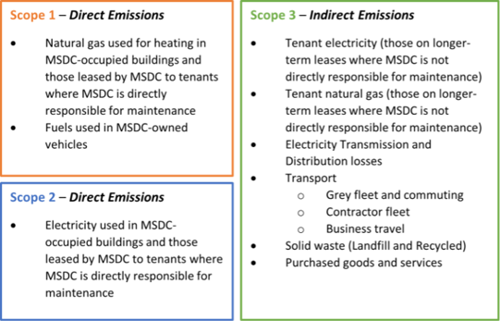
We have divided the emissions into 3 groups (scopes) to make monitoring easier to follow. What is included in the Council's Scopes 1, 2 and 3 emissions is outlined below
Council Emissions
The most recent audit of the Council’s emissions showed the following:
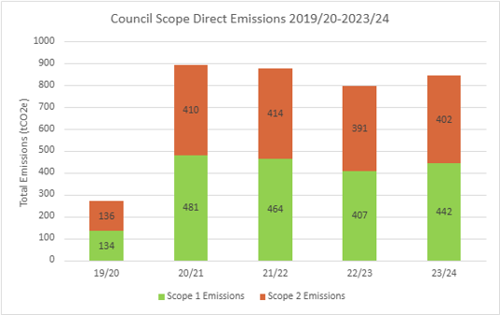
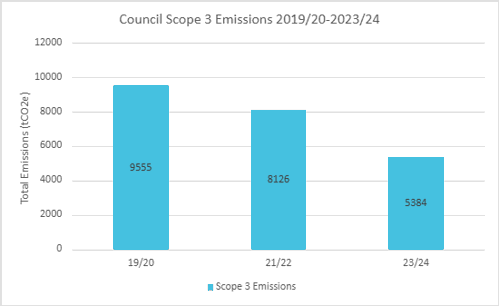
- Total Council emissions fell by 36% between our baseline report in 2019/20 and the latest reporting year 2023/24, down from 9,807 tonnes of carbon dioxide equivalent (tCO2e) to 6229 tCO2e.
- Direct Emissions: Scope 1 emissions have fallen by 8% since the baseline, down to 422.5 tCO2e. Scope 2 emissions fell by 1.9%, down to 402 tCO2e.
- Indirect Emissions: Scope 3 emissions have fallen by 44% since the baseline, down to 5384.5 tCO2e. This is largely due to a reduction in construction during this period. It is acknowledged that Scope 3 emissions could rise again owing to any future major projects.
(Please note that the rise in Scope 1 and 2 emissions since the baseline is due to a change in the methodology used to assess the emissions resulting in more Council-owned premises being redesignated as Scope 1 and Scope 2 instead of Scope 3. This is to improve alignment with best practice greenhouse gas reporting).
In-depth analysis was undertaken for the financial year 2023/24, which told us:
- Direct Emissions are 13.5% of total Council emissions, split between Scope 1 (7%) and Scope 2 (6.5%). A large part of this is from Council-owned buildings through heating and electricity consumption.
- Indirect emissions (Scope 3) are 86.5% of total Council emissions. The biggest contributors to indirect emissions are the goods and services the Council procures, which account for 42% of total emissions.
Buildings
- Solar Panels - the Council office in Haywards Heath has solar photovoltaic (PV) panels on its roof, which generated 26,962 kwh of renewable energy in 2024/25, covering 14.5% of the site’s electricity consumption.
- Heat Decarbonisation Plan – the Heat Decarbonisation Plan (HDP) for its main office in Haywards Heath has recently been completed. This has identified how to reduce energy usage, reduce fossil fuel consumption, and increase renewable energy generation on-site. The HDP is now being implemented.
Vehicles
- Council Owned Vehicles - we have now converted 100% of our operational fleet to Electric Vehicles, reducing our direct transport emissions.
- Electric Vehicle (EV) Charging at Council Office – to support and encourage staff to change to electric vehicles, five EV charging points have been installed in the staff car park.
Supply Chain
- Social Value and Sustainability Charter – the Council has agreed a Social Value and Sustainability Charter to ensure there is a commitment to support economic, environmental and social improvements from its suppliers and contractors.
Behaviour Change
- Staff E-Modules – completion of online climate modules is mandatory for all staff.
- Bronze Carbon Literate Organisation – the Council became a Bronze accredited CLO in 2024 and is working towards Silver accreditation.
- Staff Travel Survey – in 2024 we carried out a staff travel survey to better understand commuting and work travel behaviours, evaluate existing travel incentives, and identify new measures to encourage sustainable travel.
- Staff commuting incentives – offers are available to encourage staff to embrace sustainable commuting. The Council has an easitNETWORK, which gives staff access to a range of travel discounts, including 15% off Southern Rail and bus fare discounts. Any organisation in Mid Sussex can become a member of the network and offer the discounts to their employees, too. Contact Easit to discuss membership. We are also members of a Cycle to Work Scheme.
Buildings
- Heat Decarbonisation Plan (HDP) - work is underway to implement the Council’s HDP to decarbonise Council operations. This includes expanding the solar PV array and replacing gas boilers with Air Source Heat Pumps.
- Identifying opportunities for renewable energy generation across the Council’s estate, including sports pavilions and car parks.
- Developing a decarbonisation strategy for our Leisure Centres, working in partnership with Places Leisure.
Supply Chain
- Introducing minimum emissions performance requirements for council suppliers to reduce the Council’s indirect emissions and help us achieve our Net Zero targets.
- Reviewing our Social Value and Sustainability Charter to ensure consistency with our Net Zero targets and that its criteria are embedded across our procurement processes.
- Delivering training to our contract managers and procurement staff to equip them with the expertise to embed sustainability into procurement decisions and contract management.
Behaviour Change
- Developing a council-wide behaviour change campaign focused on sustainable waste management, energy efficiency, and low-carbon travel.
- Conducting a second Staff Travel Survey in Spring 2026 to measure progress since 2024.
- Trialling low-cost interventions within our Offices to increase energy efficiency.
District-wide Emissions
The most recent assessment of District-wide emissions is 2022. (This is because the Government publishes the data 2 years in arrears). This told us that Mid Sussex emissions have fallen by 11% since the baseline year of 2019/20, to 613ktCO2e.
This reduction is primarily due to lower emissions from transport (due to a general decline in petrol and diesel usage and reduced commuting since the Pandemic) and from domestic buildings (through decarbonisation of the National Grid, energy efficiency improvements and low carbon heating gains).
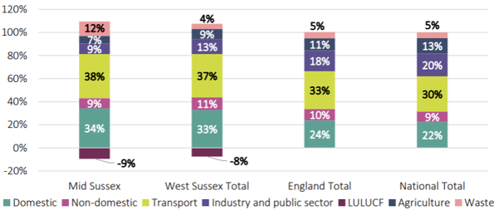
Note: LULUCF stands for Land Use, Land Use Change and Forestry. It refers to both emissions and removals from land use activities such as deforestation, grazing land management, reforestation and other land forest management. The figure is negative because Mid Sussex is a very green district, and acts as a ‘carbon sink’, which partly offsets some of the emissions produced.
The key emissions sectors in Mid Sussex are shown above, alongside comparisons with West Sussex and national data. It shows that in Mid Sussex the highest percentage of the district’s emissions come from transport (38%) and domestic emissions (34%). Waste emissions (12%) remain higher than the national average (5%) due to the importation of waste into the district for treatment and generation of energy which powers the treatment works.
Waste emissions significantly declined in 2020 and 2021 but have since returned to pre-pandemic levels, where they sit above the national average. A key contributor to this trend is the Goddards Green Waste Treatment Works, a sludge treatment facility which brings in material from the surrounding region. Waste importation and the facility’s processes produce emissions, but the thermal hydrolysis process produces almost enough electricity from biogas produced during treatment for the plant itself to be self-sustaining.
- Installation of EV Charging Points – To date, 82 EV charging points have been installed in MSDC car parks, helping to facilitate the shift towards Electric Vehicles. For more information and to get involved with consultations or to suggest future charge point locations, follow this link to the West Sussex Chargepoint Network website: West Sussex EV Chargepoint Network | Connected Kerb A video of the launch of the Network is available here.
- Parish Energy Plan – we have worked with a local community energy company - Community Energy Pathways - to create a local energy plan for Hassocks. This pilot project has provided residents with a plan to achieve community-level energy efficiency improvements and increase renewable energy provision.
- Promoting Energy Efficiency Schemes to our vulnerable residents such as the Warmer Homes programme, ECO4Flex and Connected for Warmth (see A Net Zero Home - Mid Sussex District Council for more information).
- Encouraging Active Travel – we published in 2023 our LCWIP – Local Cycling and walking Infrastructure Plan, which outlines the future potential for active travel links in and around the main urban hubs of Burgess Hill, East Grinstead and Haywards Heath. Working with West Sussex County Council and the Coast to Capital Local Enterprise Partnership we secured £21.8m to fund sustainable transport improvements in and around Burgess Hill. To date, this has delivered 14km of new and improved walking and cycling routes.
- Brookleigh Development EV Charging - the 3,500 new homes in the Brookleigh development in Burgess Hill will include EV charging points for each parking space where on-site parking is provided for residential dwellings. For the remainder, there is a minimum provision of at least one EV rapid charging point per 10 residential dwellings and / or 1000m2 of commercial.
- See the Council's Sustainable Economy Strategy for upcoming actions.