
Home Energy and Grants
In Mid Sussex, around 34% of the carbon emissions we produce come from our homes. Reducing the carbon footprint of our homes is therefore a critical part of our journey towards achieving a net zero district by 2050.
When our homes burn fossil fuels like gas or oil for heating, or draw power from the electricity grid, they generate carbon emissions. You can calculate the carbon footprint of your home using the WWF’s free calculator: WWF Footprint Calculator. Alternatively, for a more detailed breakdown of your individual carbon footprint, see Carbon calculator.
Lowering your home’s carbon emissions isn’t just good for the environment; it can also reduce your energy bills by making your home cheaper and more efficient to run.
This can initially seem complicated, so the best way to approach it is by following three steps often called the “energy hierarchy”. For more information on this, please check out our Green Retrofit Guide below.
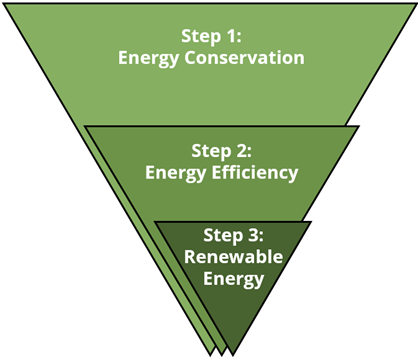
The Energy Hierarchy
Retrofitting Your Home
Check out our Green Retrofit guide for helpful tips and information on how to improve the green credentials of your home and improve its energy efficiency.
To find out more about Air Source Heat Pumps, see https://youtu.be/6-ZJAnpYMU0
Waste, Water & Travel
Addressing electricity, energy use and heating are critical to achieving net zero, but there are other important ways in which you can reduce your domestic carbon footprint too:
- Recycling your waste. Waste contributes significantly to our carbon emissions within Mid Sussex, accounting for 12% of total emissions. Recycling your waste correctly helps lower emissions by reducing the amount of rubbish sent to landfill, whilst conserving natural resources. See the Waste and Recycling section of this website for more information on what can and can’t be recycled.
- Reducing your water usage. Within the South Downs river catchment areas, the average home uses around 146 litres of water a day – the national average is 142 litres (SDNPA Water in the Park Report, 2025). At the same time, increased demand, reliance on aquifers for supply and changing rainfall patterns means that the South East is one of the most water-stressed areas of the UK. Saving water therefore builds our water resilience, as well as reducing your bills and CO2 emissions by using less energy to pump, heat and treat water. Waterwise have made a free water saving calculator to help you find out about your water usage and provide advice on how to reduce your water waste.
- Switch to an electric or low-emissions vehicle. Transport is the highest-emitting sector in Mid Sussex, accounting for 38% of all emissions. Electric vehicles emit zero tailpipe emissions. Switching to one not only reduces CO2 emissions, but also improves the air quality of the district, leading to better health outcomes. For more information on EVs, visit: Electric vehicles: all you need to know - Energy Saving Trust. We are part of the West Sussex Chargepoint Network, working with WSCC and Connected Kerb to install EV Charge Points across the county, including in MSDC car parks. Information can be found here: UK’s largest public EV charging project (connectedkerb.com)
- Consider active travel. Leave the car behind if you are able to walk or cycle – swapping just one trip a day from driving to cycling can save 0.5 tons of CO2 over a year! Use Bikemap to plan your cycling route. For local walking routes, see About the Place - Mid Sussex District Council.
Energy Efficiency Grants
A number of grant schemes are available to help residents upgrade their homes to reduce their energy consumption and lower energy bills. Please see below the list of grant schemes currently available to Mid Sussex residents:
Boiler Upgrade Scheme (BUS) - this scheme provides funding for homeowners to install heat pumps to replace fossil fuel boilers. This helps increase the energy efficiency of your home and provides long-term cost savings. For more information, visit the Government website.

Connected for Warmth - this scheme offers fully funded Air Source Heat Pumps and energy bill support for fuel poor and vulnerable homes. The scheme is currently closed for applications but check back for future funding rounds. For more information, please visit. Fully funded energy efficiency measures | Connected for Warmth.

ECO4 Flex - this scheme provides funding for energy efficiency measures such as heat pumps, solar PV, insulation and boiler upgrades to low-income and vulnerable households living in energy-inefficient homes. More details on eligibility can be found at West Sussex Affordable Energy. Please note: this scheme closed to applications March 2026. If you have submitted an application and need support, please contact the West Sussex Energy Advice Service as outlined below.

Solar Together - led by West Sussex County Council, this scheme provides significant discounts on solar PV and battery storage systems for residents and SMEs. The scheme is currently closed, but a new scheme is expected late 2026, so check back then for details.

Warm Homes: Local Grant - this government grant scheme, delivered by the Warmer Homes programme, provides fully funded energy efficiency improvements to people's homes, and is open to owner occupiers and private rental tenants on low incomes. For more information, and to check your eligibility, visit Warmer Homes. Please note: the grant scheme is currently operating a waiting list for new applicants.
For more information on the current heating and insulation grants available across Mid Sussex, please visit Heating and insulation grants - West Sussex Energy.
For grant-related queries, please contact the West Sussex Energy Advice Service as outlined below.
Advice Service
For further advice and guidance please contact the West Sussex Energy Advice Service at:
West Sussex Energy Advice Service
Call: 0800 145 6879 (Monday to Friday 10am – 4pm)
Email: energy@arunchichestercab.org.uk
Website: Arun & Chichester Citizens Advice - Energy 2023 (arunchichestercab.org.uk)
This service is provided by Arun & Chichester Citizens Advice service working in partnership with West Sussex local authorities. You are guaranteed to be provided with free, impartial, and confidential advice. The service is provided to any homeowner or renter of private or social housing in West Sussex.
For further energy advice, please visit the West Sussex Affordable Energy website and select the ‘advice’ tab’, followed by ‘Mid Sussex District Council support’.
Cost of Living
For advice on Cost of Living, please visit the dedicated support webpage: https://www.midsussex.gov.uk/cost-of-living-support/
More information
- For advice around simple low-cost actions you can take to reduce your energy bill by up to £100, check out the Government website at Clean energy - Clean Energy Homepage.
- For a simple guide to all things net zero visit: Net Zero Explained
- For more information on improving the energy efficiency of your home, see Energy at home - Energy Saving Trust.
- Check out the West Sussex Affordable Energy newsletter here: Resources - West Sussex Energy