
Mid Sussex District Council recycles over 2,000 tonnes of food waste before national deadline
- 26/03/2026
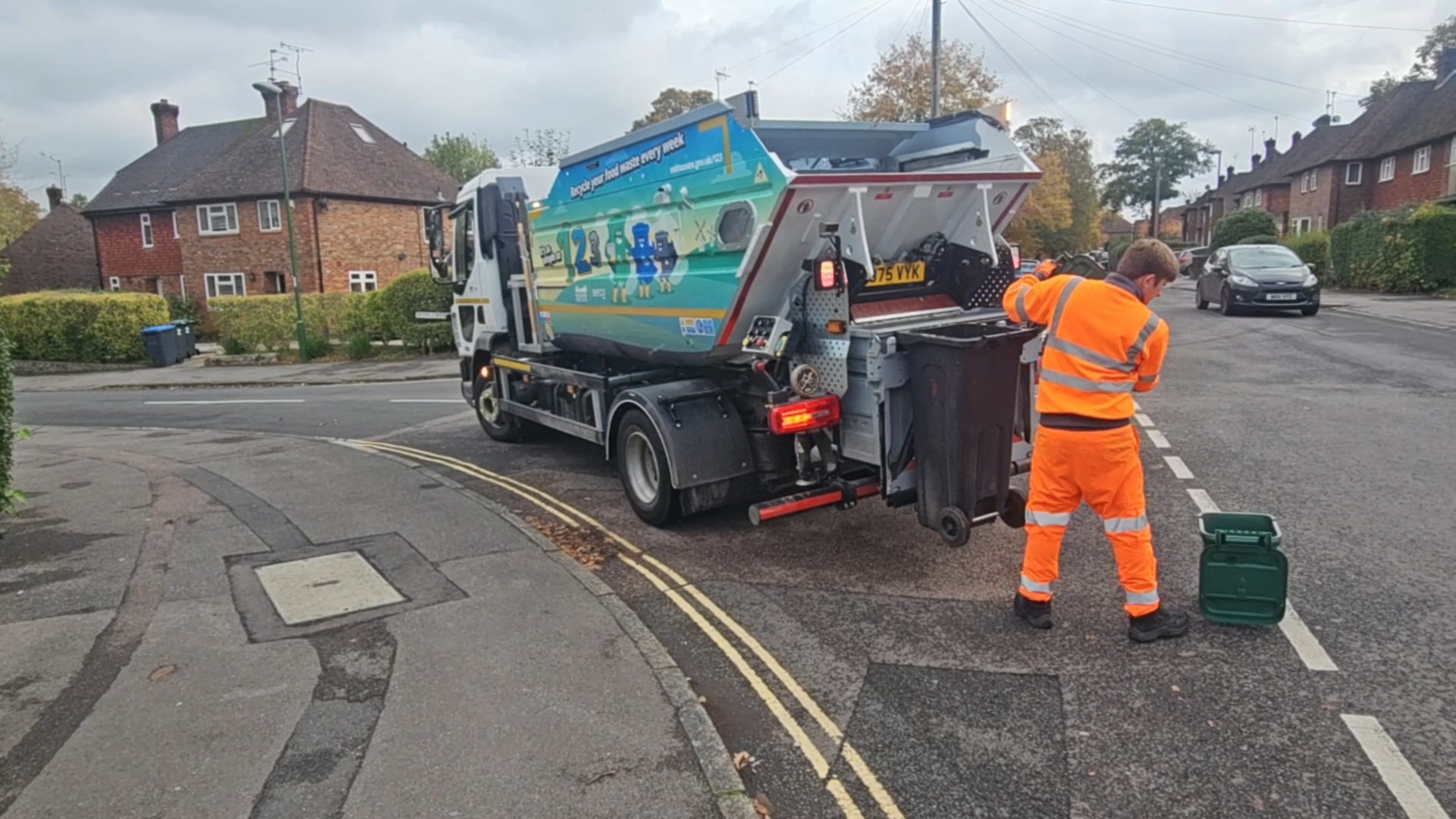
Residents in Mid Sussex have recycled more than 2,000 tonnes of food waste in four months using Mid Sussex District Council’s new collection service, ahead of the national deadline for the Government’s Simpler Recycling legislation.
The national legislation mandates that all councils must implement food waste recycling schemes by 31 March 2026. Mid Sussex District Council is leading the way in West Sussex by being the first council to roll out food waste recycling across the county, following a successful pilot since 2022.
Since the programme launched on 3 November 2025, 2,214 tonnes of food waste have been collected in Mid Sussex. This equates to around 21 tonnes per day or 2.2kg per household. This amount of food waste weighs the same as about 1,500 cars, 160 double-decker buses, or 450 African elephants.
Serving 72,000 households, the programme represents one of the largest service expansions for the district. This includes 40 new and 200 revised collection routes, and 36 new local jobs to support the service. Other positive outcomes include an overall increase in the recycling rate for the district, from 42.98% in 2024/25 to 55.59% in 2025/26, a reduction in dry recycling contamination from 5.86% to 4.07%, and a reduction in food waste in the residual waste stream of 2,537.31 tonnes over the same period.
The Council’s food waste recycling was introduced with operational support from national waste contractor, Serco, and programme management and advisory support from Founds Group, as part of a major transformation of the district’s waste and recycling services. These changes have reshaped the way waste is managed across Mid Sussex. Collections now follow a 1, 2, 3 schedule, with food waste collected every week, recycling every two weeks and general waste every three weeks.
Insights gathered from the Council’s pilot programme played a crucial role in shaping the rollout. Data collected during the pilot demonstrated the benefits and support towards recycling food waste. By separating food waste correctly, the average household had 40% less in their general waste bin each week. 87% of residents who took part in the pilot confirmed their satisfaction with the service.
Implementing food waste recycling reflects the Council’s continual commitment to deliver high-quality services for residents while also supporting a more sustainable future. By collecting food waste each week, the programme significantly reduces the amount of waste in general rubbish bins and helps create renewable fuel.
Cllr Chris Hobbs, Cabinet Member for Leisure and Customer Services, said “We’re proud to champion food waste recycling in Sussex. Delivering this service months ahead of the deadline reflects our commitment to reducing waste and supporting sustainable energy. We thank our residents and Serco crews for embracing this positive step forward for our community.”
Food waste collected across West Sussex is currently processed outside the county but will soon be recycled at the Anaerobic Digestion facility in Horsham. West Sussex County Council has invested in converting the Mechanical Biological Treatment site and updated key transfer stations to process source-separated food waste. The improved facility will efficiently turn the county’s food waste into renewable energy and biofertiliser, helping cut waste, lower emissions, and boost recycling performance across the county.
The introduction of the service coincides with the Council becoming one of the first in England to implement three-weekly general waste collections, delivered by Serco, supporting national ambitions to reduce landfill and increase recycling rates. The Government’s recycling strategy aims for 60% of domestic waste to be recycled by 2030.
Robin Mills, Serco’s Senior Contract Manager ‘South’ Region, comments:
“It has been a privilege to work in partnership with Mid Sussex District Council to deliver these important service changes. Reaching these milestones so quickly reflects the strong commitment of local residents and the exceptional hard work of our collection crews, whose professionalism and dedication deserve our sincere thanks”.
Residents across Mid Sussex have shared their experience with the programme and how it’s made a difference to their recycling habits.
“I am actually putting so much less into landfill than I’ve ever done before, and it made me realise that it was the food waste that was taking up most of the space in my kitchen bin.”
“They are doing really well, and I think it’s a great idea – I for one have had a lot less in my landfill bin.”
The Council recently launched a new app, giving residents more choice in how they access information and services. A key feature is its integration of waste management services, including bin collection dates and the option for users to set collection reminders.
The Council would like to thank residents for their patience during the rollout of new bins, routes, and collection frequencies. With some teething issues expected with a rollout of this scale, their active participation has played a key role in the programme’s success.
The Council will expand its recycling programme in line with the Government’s requirement to include soft plastics, like food packaging and wrapping, from 2027.
ENDS